
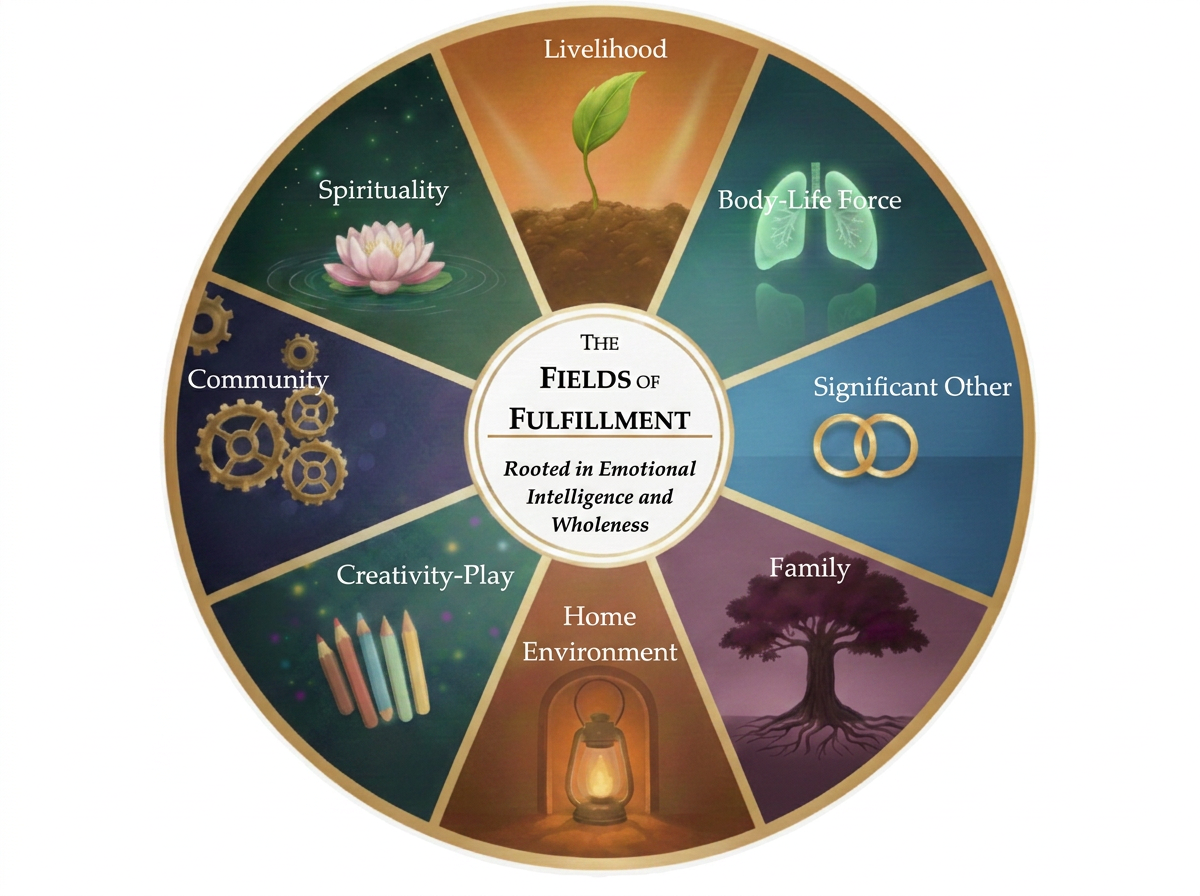
8 Fields of Fulfillment
Burnout happens when too many areas of your life run a deficit for too long. Recovery happens in two phases: first, you regulate your nervous system and stop the bleeding by identifying your unique needs and taking agency to get them met. Then, you build a life you actually love by creating fulfillment across eight essential fields. This is how you prevent burnout from coming back.
Health - Body - Life Force
This is your foundation—the vessel that carries you through life. It's the quality of your sleep, the steadiness of your energy, the way your body feels when you move. It's being nourished, hydrated, and rested. It's the difference between pushing through exhaustion and actually having vitality. Your body is constantly sending you signals—tension, fatigue, hunger, pain—and this field is about whether you're listening. It's also about touch, pleasure, and how you inhabit your physical self. When this field is full, you have the life force to show up for everything else. When it's depleted, everything else suffers.
Sleep (quality, quantity, rhythm/consistency)
Hydration
Nutrition (getting enough of the nutrients that you need, what you eat, when you eat, relationship with food)
Movement (exercise, daily activity, stretching, mobility)
Breath (breathing patterns, breathwork practices)
Touch (physical affection, massage, somatic practices)
Body image (how you see yourself, body acceptance)
Medical care (preventive care, addressing health issues, dental, vision)
Energy levels (baseline vitality, stamina)
Sensory needs (light, sound, temperature, textures)
Rest/recovery practices (beyond sleep - true rest)
Significant Other
This field is about deep, intimate one-on-one connection—though what that looks like varies widely. It might be a romantic partnership, a life partner, or a profoundly close friendship that functions as your primary emotional bond. The form matters less than the function: Do you have someone who truly sees you? Someone you can be completely yourself with? Someone whose presence in your life provides emotional safety, intimacy, and reciprocal care? It's vulnerability without performance. It's being known in your fullness and still chosen. It's having a witness to your life. When this field is thriving, you feel deeply connected. When it's depleted, isolation sets in—even if you're surrounded by people.
Emotional intimacy (feeling truly seen, understood, safe to be yourself)
Consistent presence (regular quality time, deep connection, showing up for each other)
Communication (honest, respectful, effective - can talk about hard things)
Shared values (alignment on what matters most in life)
Conflict resolution (ability to repair, work through disagreement without abandoning each other)
Reciprocal support (emotional and practical - being each other's ally)
Trust and reliability (knowing they'll be there, that you can count on them)
Fun/play together (laughter, lightness, joy, not everything is heavy)
Mutual respect (honoring each other's autonomy, boundaries, separate personhood)
Growth-supportive (encouraging each other's evolution, not threatened by change)
Appreciation expressed (gratitude, recognition, feeling valued)
Physical connection (if applicable to the relationship - affection, touch, intimacy)
Witness to your life (someone who knows your story, your context, your journey)
Spirituality
This is your relationship with meaning itself—the sense that your life is part of something larger than yourself. It might be God, nature, the universe, humanity, or simply the mystery of existence. It's the moments of awe that take your breath away. It's your values, your sense of purpose, the "why" that guides your choices. It's practices that connect you to the sacred—meditation, prayer, time in nature, ritual. It's also forgiveness, gratitude, and making peace with mortality. When this field is full, you have an anchor that holds you through life's storms. When it's empty, everything can feel meaningless.
Meaning/purpose (sense of "why" you're here)
Connection to something larger (God, nature, universe, humanity)
Values clarity (knowing what matters to you)
Practices (meditation, prayer, ritual, ceremony)
Awe and wonder (experiences of transcendence)
Forgiveness (of self and others)
Gratitude practices
Death awareness/acceptance (relationship with mortality)
Nature connection (time outside, environmental stewardship)
Faith community (if applicable)
Inner peace/contentment
Life philosophy (frameworks that guide you)
Home Environment
This is your sanctuary—the physical space where you rest, recharge, and live your daily life. It's whether your home feels like a refuge or a source of stress. It's comfort, beauty, functionality, and safety. It's natural light, clean air, and a space that actually works for how you live. It's whether you can find what you need, whether things are falling apart or holding together. Your home environment affects your nervous system every single day—cluttered chaos keeps you activated, while spaciousness lets you settle. When this field is thriving, coming home feels like exhaling. When it's depleted, you never fully relax.
Physical safety and security
Cleanliness/organization (functional level for you)
Comfort (furniture, temperature, lighting)
Aesthetics (does it feel good to be there?)
Personalization (reflects who you are)
Functionality (space works for how you live)
Clutter vs. spaciousness
Natural light and air quality
Noise levels/privacy
Outdoor space (if applicable - yard, balcony, access to nature)
Maintenance (keeping up with repairs, not falling apart)
Roommates/household dynamics (if applicable)
Sense of sanctuary (feels like refuge vs. stress source)
Livelihood
This is where your gifts meet the world's needs. It's not just about making money—though financial stability matters—it's about the satisfaction of using your talents, solving problems, creating value, contributing something that matters. It's the feeling of mastery, of getting better at something over time. It's having autonomy over your work, being recognized for what you bring, and experiencing the impact of your efforts. At its best, livelihood is work you'd still choose to do in some form even if money weren't an issue—because it engages you, challenges you, and lets you contribute in a way that feels meaningful.
Financial sustainability (however you generate it)
Using your gifts and talents
Contribution/making a difference
Mastery and growth
Creative problem-solving
Autonomy in how you contribute
Recognition/appreciation for your contributions
Boundaries around your productive time
Work relationships/collaboration
Family
This is the place where you're known across time—all the versions of yourself you've ever been. Where you can show up without performance, without curating who you are or what you're wearing. You're loved not for what you achieve or how you present, but simply because you're you. It's being seen in your full context—your history, your quirks, your evolution—and still belonging. At its best, family is the container that holds all of you, even the parts you've outgrown or are still becoming.
Connection with family of origin (parents, siblings)
Connection with chosen family
Parenting (if applicable - time, presence, relationship quality with kids)
Boundaries (healthy distance/closeness with family members)
Unresolved dynamics/healing (old wounds, patterns)
Family rituals/traditions (gatherings, celebrations)
Support given and received
Acceptance (being yourself vs. performing a role)
Communication patterns (honest, superficial, conflictual)
Extended family relationships (grandparents, aunts/uncles, cousins)
Legacy/generational patterns (what you're passing on or breaking)
Community
This is your village—the web of connections beyond your immediate family. It's friendships that nourish you, groups where you belong, people who know your name and care that you exist. It's both receiving support and offering it. It's celebrating together and grieving together. It's the barista who knows your order, the neighbor you wave to, the book club that lights you up, the volunteers you serve alongside. Community is the antidote to isolation. It's the reminder that you're part of something larger, that your presence matters, that you don't have to do life alone.
Friendships (depth, frequency, reciprocity)
Social connection (feeling part of something)
Belonging (places/groups where you're known and accepted)
Contribution (giving back, volunteering, helping)
Shared interests/activities (hobbies, clubs, groups)
Neighborhood/local community (knowing neighbors, local involvement)
Professional/networking community
Online/virtual community (if meaningful)
Diversity of connections (different contexts, ages, backgrounds)
Asking for and receiving help
Celebration and grief shared with others
Play- Creativity
This is where you create for the pure joy of it—no productivity agenda, no outcome required. It's painting, cooking, dancing, writing, building, gardening, music. It's the hobbies that make you lose track of time. It's play for its own sake—goofing around, experimenting, being terrible at something new just because it's fun. It's laughter, spontaneity, and permission to not take everything so seriously. This field is often the first to go when you're burned out, dismissed as "frivolous" or "someday." But it's essential. It's where you remember that life isn't just about surviving—it's about being alive.
Creative expression (art, writing, music, cooking, crafting)
Play for its own sake (no productivity agenda)
Hobbies (activities you do for enjoyment)
Experimentation/trying new things
Flow states (losing track of time in engagement)
Humor/laughter (lightness, not taking everything seriously)
Imagination (daydreaming, visualization, possibility-thinking)
Beauty creation or appreciation (aesthetics, design)
Learning for curiosity (not career advancement)
Adventure/novelty (breaking routine, exploring)
Permission to be a beginner (low-stakes exploration)
Playfulness in daily life (spontaneity, silliness)